Emergency Demolition in Pensacola: A One-Week Deadline
Explore emergency demolition at Pensacola naval air station: a 35,000-square-foot warehouse, massive steel spans, and a one-week air show deadline.
Emergency demolition at the Pensacola naval air station meant facing an enormous assignment on a very short schedule: bring down a 35,000-square-foot warehouse with only one week available before the Blue Angels homecoming air show. The building stood 60 feet tall, with massive 180-foot clear spans and beams described as 1 inch thick and 5 feet tall. This was large-scale structural demolition under an event-driven deadline—not a routine warehouse teardown.
The owner's account places the last-minute assignment after Hurricane Isaias. Those project details establish the challenge: a substantial steel structure, an urgent removal window, and a location known as the home of the Blue Angels. Understanding this job starts with understanding why its dimensions and deadline mattered so much.
A One-Week Deadline at the Pensacola naval air station
The assignment was straightforward to describe but demanding to plan: get the warehouse down before the Blue Angels homecoming air show. Having a week available creates a very different planning environment from a demolition project with a flexible start date and an open-ended schedule.
On a project of this kind, equipment availability, site access, structural assessment, and material handling all need early attention. A delay in one area can affect the entire operation. The building cannot be treated as an isolated task while access arrangements and debris logistics wait until later.
The location adds another layer of coordination. Work at a naval installation requires communication with the responsible facility representatives about access, boundaries, and surrounding activities. Specific arrangements depend on the installation and the assignment; they should never be assumed from an ordinary commercial demolition checklist.
The one-week window describes the deadline given for this project. It is not a standard completion promise for other large warehouses, even those with similar square footage.
What Made This 35,000-Square-Foot Warehouse Different
Floor area tells only part of the story. At 35,000 square feet, the warehouse already represented a substantial removal scope. Its 60-foot height introduced a separate challenge: reaching and managing structural components far above ground level.
Equipment selection for a tall industrial building depends on more than whether a machine can reach the roof. Working distance, structural condition, ground conditions, and the weight and behavior of building components all influence the plan. Those decisions require site-specific professional evaluation.
The 180-foot clear spans were another defining feature. A clear span provides a large open space without intermediate supports across that span. That openness is useful while a warehouse is operating, but it means demolition planning must account for how the long-span framing is supported and connected.
The owner also described beams measuring 1 inch thick and 5 feet tall. Those dimensions communicate the scale of the members involved, but they do not establish an exact beam weight. Length, cross-section, connections, and material specifications would be needed for that calculation. Heavy steel demolition cannot be planned from appearance alone.
What the Warehouse Demolition Photo Shows
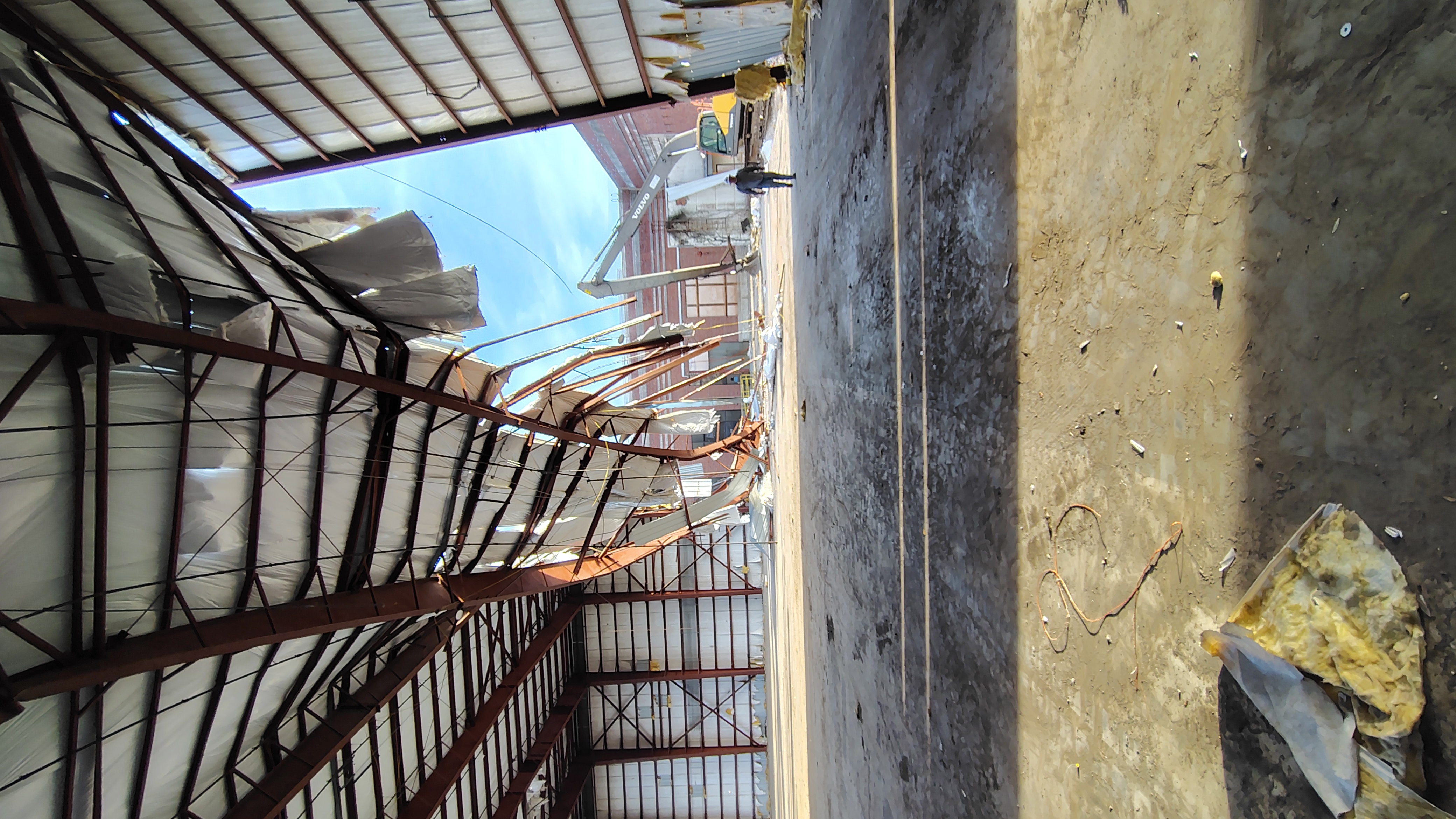
The project photograph makes the scale concrete. Large reddish-brown steel framing extends across the interior, with roof and wall surfaces still visible around it. White facing or insulation hangs in torn sections, and a large opening exposes the blue sky.
Bent or displaced framing is visible near the opening. Metal pieces, insulation, and other debris lie across the floor. An excavator appears toward the right side, and a person wearing a hard hat is visible in the interior.
These details illustrate a building in a visibly disrupted condition. However, a photograph cannot establish the stability of the remaining frame, identify every hazard, or distinguish all storm damage from changes made during demolition.
That distinction matters in hurricane-related work. Visible damage is a reason for professional assessment, not a substitute for one. Property owners should not enter a damaged warehouse to inspect hanging materials or take closer photographs.
Emergency Demolition After a Hurricane Requires Assessment
Emergency demolition does not mean skipping the decisions that make structural removal controlled and accountable. After severe weather, qualified professionals need to evaluate the remaining structure and determine how its condition affects the work.
For a warehouse with tall framing and long spans, that evaluation should consider connections, bracing, displaced members, and loose overhead materials. Utilities and potential hazardous building materials also need attention before the removal approach is finalized.
The photograph's hanging insulation and exposed framing demonstrate why ground-level appearances can be misleading. A floor may look accessible while hazards remain overhead. Keeping unauthorized people away from a damaged building is an important early precaution.
Weather remains relevant during planning as well. Wind and changing conditions can affect exposed materials and equipment operations. An urgent deadline makes preparation more important; it does not make the building's condition less significant.
Planning Large-Scale Demolition Around an Air Show
An upcoming air show gives a demolition deadline a clear operational purpose. The work must be coordinated with the people responsible for the facility and event preparations, rather than scheduled solely around equipment availability.
It is also important to define what “down” means in the agreed scope. Structural removal, debris hauling, foundation removal, and final site preparation are different tasks. The owner's description establishes the warehouse removal deadline but does not specify every closeout requirement.
For comparable projects, clarifying those boundaries early helps everyone understand the schedule. Access routes, material staging, hauling arrangements, and the condition expected at handover should be discussed before work begins.
The main lesson from this Pensacola assignment is that urgency and scale must be considered together. A 60-foot-tall warehouse with 180-foot spans needs a plan built around its actual structure—not simply a faster version of a small-building demolition plan.
Frequently Asked Questions
How large was the warehouse at the Pensacola naval air station?
The owner described a 35,000-square-foot warehouse standing 60 feet tall. Its structural features included 180-foot clear spans and beams described as 1 inch thick and 5 feet tall.
Why was there only one week for demolition?
According to the project description, the warehouse needed to come down before the Blue Angels homecoming air show. That was the assignment's available window, not a general timeline for similar buildings.
Can every hurricane-damaged warehouse be demolished immediately?
No. Structural conditions, access, utilities, environmental considerations, and applicable approvals affect readiness. Requirements and timelines vary, and Jericho can help clarify the demolition scope and coordination needed for a particular property.
What information helps when requesting an emergency demolition quote?
Provide the location, approximate building size and height, known damage, access limitations, and required deadline. Share existing photographs taken from a safe location; do not enter an unstable structure to gather information.
For urgent warehouse or storm-related demolition needs, contact Jericho Demolition, a faith-driven Florida Certified General Contractor, CGC#1538467, focused on demolition only. Serving all of Florida with an office in Pensacola, Jericho can discuss your project requirements. Get an instant quote at jerichodemolition.com or call 251-716-8799, Monday–Saturday, 7am–7pm.